by
Mashfique Hussain Chowdhury
Introduced during
the 2002 model year, the compact
Mitsubishi Lancer was redeveloped
from the ground up. The new car
highlighted a new level of
refinement for Mitsubishi economy
cars, and set it up as a credible
contender to the Corolla and Civic.
For 2004, the boring front end was
redesigned along with other minor
revisions.
Two versions of
the Lancer are officially offered in
the region. The entry-level model is
the rather basic 1.3-liter GL, while
the higher model is the 1.6-liter
GLX. Mitsubishi offers various other
Lancer models in American and
European markets, with 2.0-liter and
2.4-liter engines, in sedan and even
wagon trims. Sadly, local buyers
have to be content with the weaker
economy models offered here. The
muscular all-wheel-drive Evolution
models are a completely different
story and need not be mentioned in
the same breath as the basic Lancer.
Both 1.3-liter and 1.6-liter models
are offered with either a 5-speed
manual or a 4-speed automatic
gearbox. There is apparently also a
gearless CVT transmission available
in many Middle Eastern markets for
the 1.6-liter model, which drives
like an automatic, but has no actual
gears and therefore no shift shock.
Mitsubishi claims
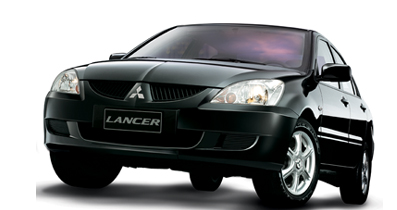
that the Lancer's styling is
European-inspired. The sedan's
cab-forward profile incorporates a
high roofline on a comparatively
long wheelbase. The fender lines are
relatively high, and sharp edges
blend with soft curves. The turn
signals are mounted on the front
fender, and the grille is in the
shape of two triangular plastic
nostrils in black. Aerodynamic
wraparound headlights have a
multi-reflector surface, and the low
bumper has a large opening for
additional airflow into the engine
compartment. It looks fairly
aggressive, with wheels pushed to
the edges of the boxy body, which
makes for an odd profile when
combined with the steeply raked
windshield. The hood has stepped
cut-lines and the back end is
highlighted with unique transparent
tail-lights.
The Lancer gets
14-inch wheels and plastic hubcaps,
while 15-inch alloy wheels and
sunroof are optional. On the safety
front, front airbags and ABS brakes
are standard on the higher model and
optional on the base sedans. Power
windows, power mirrors and a basic
radio cassette stereo are available,
but not much else. We are not sure
what other options might be
available since we were nearly
ignored at the somewhat busy
dealership, even though we went in
posing as normal customers. They did
not even have a brochure available.
Maybe young folks like us are not
taken seriously, even though many in
our generation are able to afford
cars far more expensive than any
Mitsubishi. We finally ended up
testing nearly new examples
belonging to acquaintances and found
out some other facts from the
company's head office.
Five people fit
inside the Lancer. A low instrument
panel and belt line help with
visibility, and a high hip point for
the seats should ensure easier entry
and exit. Visibility is also helped
by the large windows and narrow
pillars. Seating surfaces seem to be
made of a durable cloth. The front
seat features firm seats and ample
space, but a little more side
bolstering as well as padding
would've made them more comfortable
during cornering. The dashboard
material looks and feels pleasant,
although the flat design is
reminiscent of a big ugly pickup
interior. All buttons are of a high
quality, except for the flimsy a/c
knobs. The stereo is rather basic,
with a manual antenna and no CD
player. The gauges are easy to see
in the daytime but aren't quite
bright enough at night. There are
two cup holders between the front
seats, but they all only hold one
size of cups. Only the passenger sun
visor has a mirror. Rear-seat
headroom is just about enough for
tall people, but legroom is adequate
only when the front seats are not
pushed all the way back. In fact,
the Lancer is surprisingly spacious
given its wedged profile, but is not
as large inside as the balloon-like
Corolla. Luggage boot space is good,
but the lid hinges and oddly-shaped
rear tyre bulges intrude into
useable space. One good feature is
the 60/40 fold-down rear seat to
carry larger items.
Build quality is
very good, matching a lot of the top
Japanese competitors, with
well-fitting body panels and doors
that close with a nicely-muffled
sound. However, we question the
durability of the soft rubber seals
around the doors, the plastic around
the shifter and the strength of a
few exterior plastic pieces.
The 1.3-liter,
16-valve four-cylinder engine in the
GL develops 90 hp and 114 Nm of
torque. A five-speed-manual
transmission is standard, and the
optional four-speed automatic has
adaptive shift control. The
1.6-liter four-cylinder engine goes
into the better-optioned GLX sedan.
This larger engine develops 122 hp
and 153 Nm of torque. The GL
struggles with the 1.3-liter engine,
especially when overtaking, and has
to be revved quite high in order to
get a good running start when
merging with highway traffic. In
contrast, the 1.6-liter engine can
handle the strain of daily driving
with more ease. The GLX is by no
means very quick, but is suitable
for most driving highway driving
conditions, especially with the
manual transmission. Peak torque
comes up at about 4000 rpm on both
engines, which means both engines
need to be constantly revved high
for decent acceleration. The manual
offers good shift feel, but the
nature of the clutch may make it
hard to complete gear changes
smoothly. The optional automatic
gearbox is a smooth shifter, but
robs a noticeable amount of power
from both engines. Engine buzz is
obvious at high rpm, but the Lancer
is as quiet as most Japanese
four-cylinder cars.
The
four-wheel-independent suspension
uses front struts and a rear
multilink configuration. The Lancer
is not the kind of car that stands
high in the sporting crowd. Despite
its motorsports heritage, the
"normal" Lancer lacks the total
confidence that defines the
Lancer-based Evolution rally car.
But it is wholly satisfying as a
small family or commuter car.
Handling is adequate as the Lancer
corners easily at normal speeds, but
some drivers may prefer more
tenacity in turns. Choppiness is
minimal but not completely absent.
The thin tyres squeal like dying
rats when a roundabout is taken at
above-average speeds.
Brake pedal feel
is good, but braking performance
itself is somewhat lacking. With
small discs up front and drums at
the back, coming to a quick stop
requires nearly flooring the brake
pedal. In comparison, a Civic brakes
with less pedal pressure in similar
situations. The ABS system is a must
to effectively stop this car in an
emergency, given the skinny tyres.
In the end, we
definitely recommend the Lancer. It
is almost as good as models from
Toyota and Honda, at a slightly
lower price. It has heavily improved
over previous versions of the Lancer
from five years ago, with a more
upscale feel externally, even though
the interior is very bare in terms
of features. Still, it is a good buy
indeed for the average commuter and
young family man.